Only 9.1% of EU businesses offer chat support on their website
Eurostat surveyed enterprises in all 27 member states. Website chat is still rare, it barely moved in two years, and AI use has now overtaken it. The country-by-country data, charted.
The muro team
muro.chat
- Published
- Reading time
- 7 min
On this page
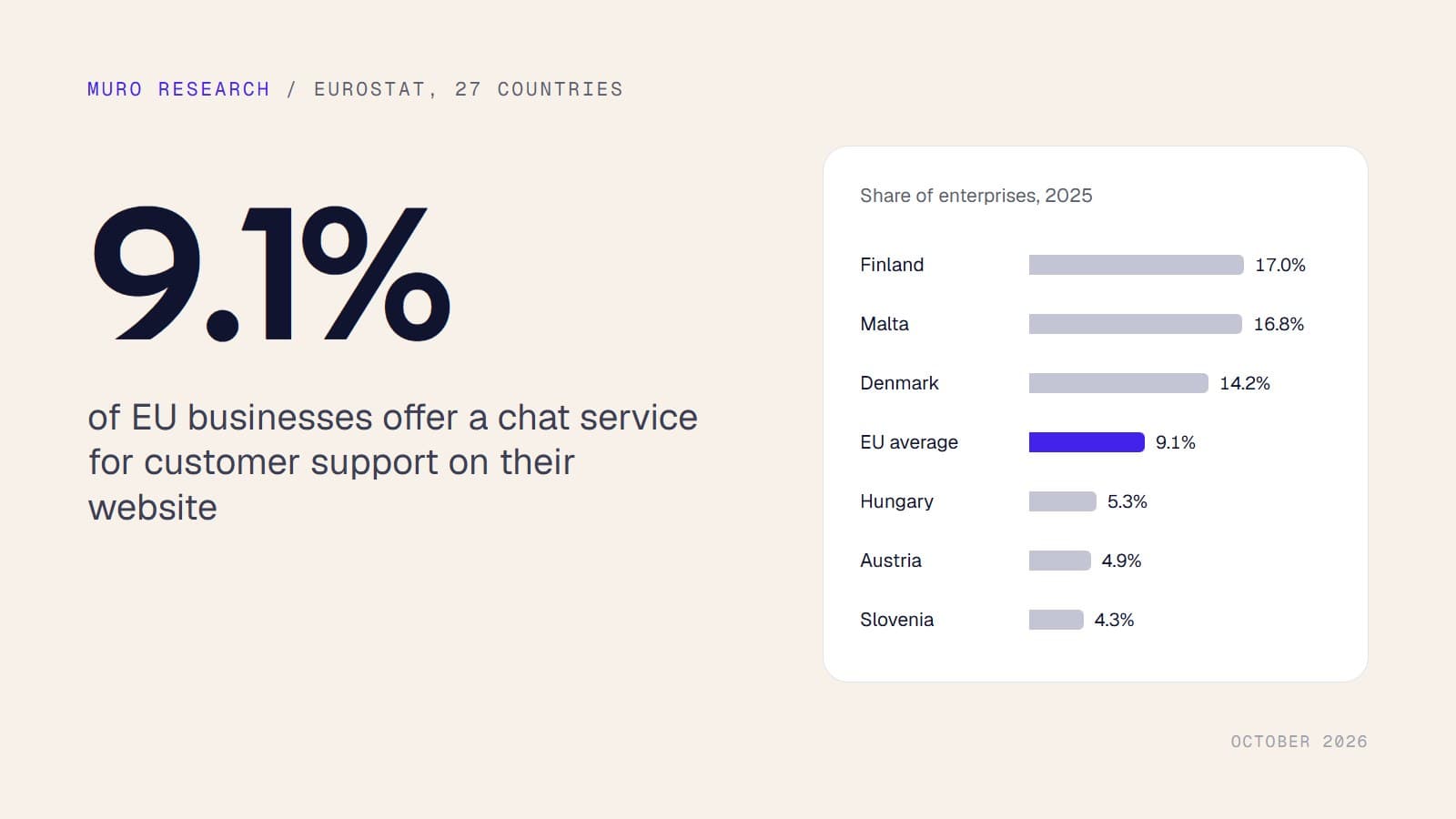
Every vendor in our industry will tell you that customers expect live chat. The official numbers say most businesses still do not offer it. In Eurostat's 2025 survey of ICT use in enterprises, 9.1% of EU businesses with 10 or more employees had a chat service for customer support on their website, whether answered by a person, a chatbot or a virtual agent. Two years earlier the figure was 8.8%.
We pulled the full country and size breakdown from Eurostat, added the AI adoption series from the same survey programme, and charted both. Everything below comes from two public Eurostat datasets; the extract we used is downloadable at the end of the article.
9.1%
of EU enterprises (10+ employees) have a support chat on their website, 2025
20.8%
among large enterprises (250+ employees)
19.9%
use at least one AI technology, up from 7.7% in 2021
52.7%
of those that considered AI and did not adopt it cite data protection concerns
Website chat by country
The spread between countries is wide. Finland (17.0%), Malta (16.8%) and Denmark (14.2%) lead; Hungary (5.3%), Austria (4.9%) and Slovenia (4.3%) close the list. The two largest EU economies both sit below the average: Germany at 7.7% and France at 6.6%.
Enterprises whose website provides a chat service for customer support, 2025
Share of enterprises with 10 or more persons employed, EU member states. A chatbot, a virtual agent or a person replying all count.
View as table
| Enterprises whose website provides a chat service for customer support, 2025 | Note | |
|---|---|---|
| Finland | 17.0% | |
| Malta | 16.8% | |
| Denmark | 14.2% | |
| Netherlands | 13.3% | Eurostat flags a break in the time series for this value. |
| Sweden | 12.9% | |
| Italy | 12.6% | |
| Spain | 12.4% | |
| Belgium | 10.4% | |
| Lithuania | 10.2% | |
| Portugal | 9.6% | |
| Ireland | 9.4% | |
| EU average | 9.1% | |
| Slovakia | 8.4% | |
| Romania | 8.3% | |
| Greece | 8.2% | |
| Czechia | 8.1% | |
| Luxembourg | 8.0% | |
| Germany | 7.7% | |
| Bulgaria | 7.5% | |
| France | 6.6% | |
| Latvia | 6.5% | |
| Estonia | 6.4% | |
| Cyprus | 6.3% | |
| Poland | 6.1% | |
| Croatia | 5.4% | |
| Hungary | 5.3% | |
| Austria | 4.9% | |
| Slovenia | 4.3% |
Source: Eurostat, isoc_ciweb, indicator E_WEBCHT, 2025.
There is no obvious north-south or east-west pattern. Finland, Denmark and Sweden are near the top, but so are Malta, Italy and Spain, while Austria and Slovenia, both above the EU average for AI use (see below), are at the bottom. Website chat does not simply follow general digital maturity.
Size matters more than geography
Large enterprises are two and a half times as likely to offer website chat as small ones: 20.8% against 8.3%. They are also where the growth is. Between 2023 and 2025 the share rose by 2.5 points among large enterprises and by 0.2 points among small ones.
Website chat for customer support, by enterprise size, EU
Share of enterprises in each size class (persons employed).
- 2023
- 2025
View as table
| 2023 | 2025 | |
|---|---|---|
| Small (10 to 49) | 8.1% | 8.3% |
| Medium (50 to 249) | 11.3% | 11.6% |
| Large (250+) | 18.2% | 20.8% |
| All (10+) | 8.8% | 9.1% |
Source: Eurostat, isoc_ciweb, indicator E_WEBCHT, EU27.
For a small business the question is rarely the software. A chat that nobody answers is worse than no chat, and a team of fifteen does not have someone to sit on it. That is the gap the 2020 edition of the survey already showed: when Eurostat asked separately who replies, 11.9% of enterprises had a chat service answered by a person and only 2.3% one answered by a chatbot or virtual agent.
AI use has overtaken website chat
The same survey programme tracks AI. In 2025, 19.9% of EU enterprises used at least one AI technology, more than twice the share that offers chat support on its website. In 2021 it was 7.7%. The fastest-growing category is the one behind chat assistants: technologies that generate written or spoken language went from 1.3% to 8.8%.
Source: Eurostat, isoc_eb_ai, EU27. "AI for marketing or sales" is the purpose category in which Eurostat places customer-facing uses such as chatbots.
Only 6.9% of enterprises use AI for marketing or sales, the category that covers customer-facing assistants. That is about 35% of the enterprises that use AI at all: for the other two thirds, AI is pointed inward, at documents, text analysis and internal workflows, not at customers.
Enterprises using at least one AI technology, 2025
Share of enterprises with 10 or more persons employed, EU member states.
View as table
| Enterprises using at least one AI technology, 2025 | Note | |
|---|---|---|
| Denmark | 42.0% | |
| Finland | 37.8% | |
| Sweden | 35.0% | |
| Belgium | 34.5% | |
| Luxembourg | 33.6% | |
| Netherlands | 33.2% | Eurostat flags a break in the time series for this value. |
| Austria | 29.9% | |
| Germany | 26.0% | |
| Estonia | 23.4% | |
| Slovenia | 21.6% | |
| Malta | 21.5% | |
| Lithuania | 21.3% | |
| Spain | 20.3% | |
| EU average | 19.9% | |
| Ireland | 19.6% | |
| France | 18.2% | |
| Slovakia | 18% | |
| Czechia | 17.6% | |
| Italy | 16.4% | |
| Croatia | 15.2% | |
| Latvia | 12.2% | |
| Portugal | 11.5% | |
| Hungary | 10.4% | |
| Cyprus | 9.3% | |
| Greece | 8.9% | |
| Bulgaria | 8.6% | |
| Poland | 8.4% | |
| Romania | 5.2% |
Source: Eurostat, isoc_eb_ai, indicator E_AI_TANY, 2025.
Why businesses that looked at AI did not adopt it
Eurostat also asks enterprises that considered AI but do not use it what stopped them. Lack of expertise comes first (70.3%). The two reasons that grew the most since 2023 are legal and privacy ones: lack of clarity about the legal consequences went from 45.5% to 53.6%, and concerns about data protection and privacy from 42.4% to 52.7%. Cost moved the other way, from 45.8% to 38.4%.
Reasons for not using AI, among enterprises that considered it
Share of EU enterprises (10+ employees) that ever considered using AI technologies. Several answers possible.
- 2023
- 2024
- 2025
View as table
| 2023 | 2024 | 2025 | |
|---|---|---|---|
| Lack of relevant expertise | 68.8% | 70.9% | 70.3% |
| Unclear legal consequences | 45.5% | 52.5% | 53.6% |
| Data protection and privacy concerns | 42.4% | 48.8% | 52.7% |
| Costs seem too high | 45.8% | 33.3% | 38.4% |
| AI is not useful for the enterprise | 20.0% | 20.7% | 17.8% |
Source: Eurostat, isoc_eb_ai, indicators E_AI_BLE, E_AI_BLEG, E_AI_BCDP, E_AI_BCST, E_AI_BNU, unit PC_ENT_AI_EC, EU27.
Read together, the picture is consistent. Money is becoming less of an obstacle while "is this legal, and where does the data go" is becoming more of one. For anything that puts AI in front of customers, that question lands on the vendor: where the conversations are stored, which AI provider reads them, and whether it can be switched off.
How to read these numbers
- Population. Enterprises with 10 or more persons employed, all activities except agriculture, forestry, fishing, mining and the financial sector. Micro-enterprises, the bulk of all companies, are not covered.
- What counts as chat. From 2023: a chat service for customer support provided on the website, answered by a chatbot, a virtual agent or a person. Contact forms and social messaging do not count.
- What counts as AI. Any of the technologies Eurostat lists, from text mining and speech recognition to machine learning and language generation.
- Barriers. The percentages are shares of the enterprises that ever considered using AI, not of all enterprises.
- Breaks in series. Eurostat flags the Netherlands 2025 values with a break in the time series; treat year-on-year comparisons for that country with care.
Sources
- 1Eurostat, Websites and functionalities by size class of enterprise (isoc_ciweb) (accessed 2026-10-10)
- 2Eurostat, Artificial intelligence by size class of enterprise (isoc_eb_ai) (accessed 2026-10-10)
- 3Eurostat API used to extract the data (dissemination API, JSON-stat) (accessed 2026-10-10)