AI Act Article 50 and support chatbots: what has applied since 2 August 2026
People must be told when they are talking to an AI system. The duty is live, the summer 2026 amendment did not delay it, and the Commission has said what a compliant disclosure looks like. The text, the dates and the fines, quoted from the sources.
The muro team
muro.chat
- Published
- Reading time
- 9 min
On this page
- The sentence itself
- When and how the person must be told
- Who is the provider when the chat is a product you bought
- Support chatbots are named, and they are not "obvious"
- What a sufficient disclosure looks like
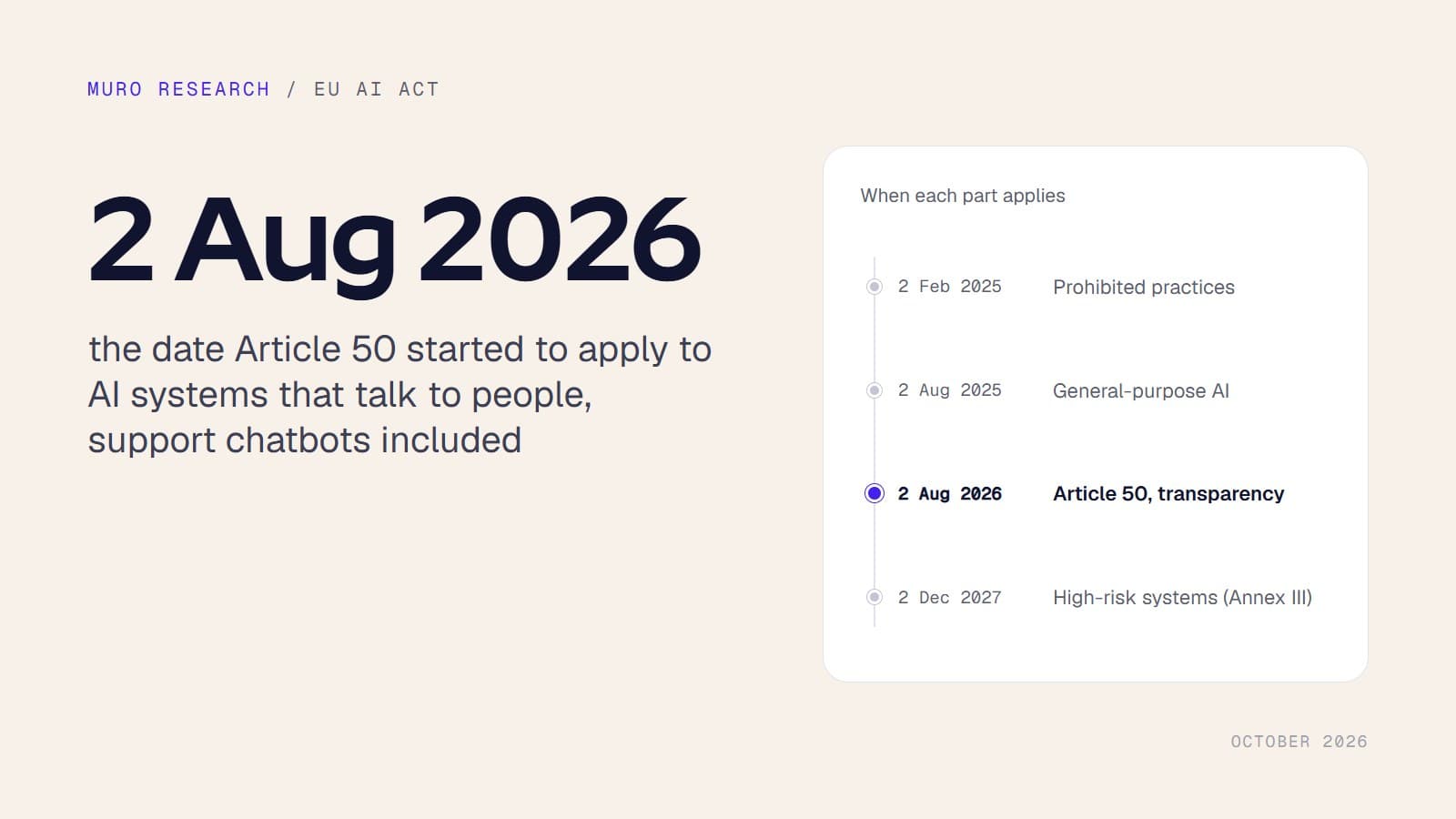
- The dates, after the July 2026 amendment
- The fines
- Status of the guidance
- A short checklist for a support chat
- Sources
If your website has a chat that an AI can answer, one sentence of EU law now applies to it. It has been in application since 2 August 2026, and much of what is written about it is either out of date or wrong about who it binds. This article quotes the texts directly: Regulation (EU) 2024/1689 as amended in July 2026, and the Commission guidelines on Article 50.
2 Aug 2026
Article 50 applies. The July 2026 amendment did not move this date
€15M or 3%
ceiling of the fine for breaching Article 50, whichever is higher
The lower
of the two for SMEs and, since 2026, small mid-caps
2 Dec 2026
extra time for one duty only: machine-readable marking by older generative systems
The sentence itself
“Providers shall ensure that AI systems intended to interact directly with natural persons are designed and developed in such a way that the natural persons concerned are informed that they are interacting with an AI system, unless this is obvious from the point of view of a natural person who is reasonably well-informed, observant and circumspect, taking into account the circumstances and the context of use. This obligation shall not apply to AI systems authorised by law to detect, prevent, investigate or prosecute criminal offences, subject to appropriate safeguards for the rights and freedoms of third parties, unless those systems are available for the public to report a criminal offence.”
Three things are worth noticing. The duty is addressed to providers, not to whoever puts the chatbot on a website. It is a design duty: the system has to be built so that people are informed. And the only general way out is that the AI nature of the interaction is "obvious", judged from the point of view of a reasonably well-informed person in that context.
When and how the person must be told
“The information referred to in paragraphs 1 to 4 shall be provided to the natural persons concerned in a clear and distinguishable manner at the latest at the time of the first interaction or exposure. The information shall conform to the applicable accessibility requirements.”
So: clearly, distinguishably, and no later than the first interaction. The Commission guidelines add that this means at least once at the start of each interactive session, and for every new person, not only the first one who ever used the system.
“Article 50(5) AI Act requires the information to be provided to the natural persons concerned at the latest at the time of the first interaction or exposure. The first interaction or exposure refers not only to the first natural person interacting with or exposed to (the output of) an AI system, but also any subsequent, first interaction with or exposure to (the output of) the AI system by any other natural person. As regards the first interaction with an AI-system, the information should, at least, be provided once at the start of an interactive session, while considering the specific contexts mentioned in point above. [...] First interaction: when launching a conversation with a chatbot or starting physical interaction with an AI system.”
Who is the provider when the chat is a product you bought
“‘provider’ means a natural or legal person, public authority, agency or other body that develops an AI system or a general-purpose AI model or that has an AI system or a general-purpose AI model developed and places it on the market or puts the AI system into service under its own name or trademark, whether for payment or free of charge;”
“‘deployer’ means a natural or legal person, public authority, agency or other body using an AI system under its authority except where the AI system is used in the course of a personal non-professional activity;”
A company that sells or offers a chatbot under its own name is a provider. So is an organisation that built its own chatbot and runs it itself. A business that switches on the AI feature of a chat product it subscribes to uses the system "under its authority", which is the definition of a deployer. Under Article 50, deployers have duties for emotion recognition and biometric categorisation systems, for deepfakes and for AI-generated text published to inform the public (paragraphs 3 and 4), not for chatbot disclosure.
“According to Article 3(3) AI Act, providers are natural or legal persons, public authorities, agencies or other bodies that develop AI systems, or have them developed, and place them on the Union market or put them into service under their own name or trademark, whether for payment or free of charge. Providers must comply with the relevant transparency obligations in Article 50(1) and (2) AI Act applicable to them, irrespective of whether they are established or located within the Union or in a third country. [...] Providers must ensure their interactive or generative AI systems have transparency embedded into the system’s design and operation and ensure all relevant transparency obligations in Articles 50(1), (2) and (5) AI Act are met at the latest when those systems are placed on the market or put into service. All natural persons interacting with the AI system or exposed to its outputs in scope must be effectively and consistently informed throughout the lifecycle of the AI system, as placed on the market or put into service by that provider (irrespective of who the deployers or other users of the system are). For example, a company provides a generative or interactive AI application (e.g. a chatbot, image generator, AI agent) on the Union market under its own name or trademark to consumers, professional users or other legal entities who may directly use the AI system for interaction or content generation (including by integrating the system into their existing processes and using it accordingly without the need for modifications or additional components). The company is a provider responsible for compliance with the transparency obligations in Article 50(1) and/or (2) AI Act, regardless of whether the AI system is provided for free or for payment and regardless of whether the provider is established or located in the Union or in a third country. Another example of a provider is a company or another organisation (e.g. a public authority) that has developed an interactive AI system (e.g. chatbot) in-house and puts it into service in the Union for its own use and under its name or trademark.”
Support chatbots are named, and they are not "obvious"
The guidelines list the systems in scope of Article 50(1). Customer support is in the first line.
“Examples of AI systems intended to interact directly with natural persons falling within scope of Article 50(1) AI Act: - AI-enabled voice assistants, chatbots/conversational agents in various contexts (e.g. public service, customer support, complaints management, e-commerce, finance, healthcare, education etc.), - AI hotline for incidents, fraud or other reporting, (humanoid) robots/cobots, AI companions; robotic companion pets; AI avatars (e.g. in virtual reality environments), - AI bots on social networks and media, coding agents and other AI agents capable of directly interacting with natural persons (including in complex multi-agent architectures).”
They then deal with the "obvious" exception, and say it must be read narrowly.
“The exception should be interpreted restrictively given that it deprives natural persons from the protection and the right to be informed with clear and distinguishable disclosures that they are interacting with AI systems. The general awareness of consumers and other natural persons that AI systems (including chatbots and agents) exist does not imply that they recognise them in interactions.”
Among the examples that do not qualify for the exception, the guidelines list "AI chatbots embedded in online platforms or assistance support tools (helpdesks) whereby users directly interact and receive AI outputs (e.g. replies to queries or other AI-generated content) they may perceive as human-generated". A support widget where a person and an AI can both answer is exactly the case where a visitor cannot tell.
What a sufficient disclosure looks like
“Textual disclosure (User Interface (UI)-based): Prominent, plain-language labels or banners (e.g. “You are interacting with an AI system”) and first-turn greetings in chatbots that may be combined, as appropriate, with persistent badges or labels visible throughout the interaction as proportionate to the specific context and risks. Furthermore, it is recommended to position accompanying disclosures close to the interaction interface (e.g. near the input/output field) and use simplified wording, particularly for users with lower digital literacy and children.”
These are examples from non-binding guidance, not a mandatory format.
“Certain techniques are not necessary and, when used alone, insufficient for effectively fulfilling the transparency obligation in Article 50(1) and (5) AI Act, notably: - Disclosures contained only in terms and conditions, URLs, or documentation (such disclosures may complement, though not replace, in-context disclosure); - Machine-readable markings (e.g. metadata or watermarks) that are not perceivable by users at the point of interaction. This does not affect the appropriateness of such marks to comply with Article 50(2) AI Act (see Section 4); - Unclear or ambiguous signals (e.g. generic references to “assistant”) or human-like representations that may mislead users; - Generalised disclosures that are not sufficiently specific to the AI system’s outputs and interactions (e.g. on a platform providing a variety of services or individual inputs, a general disclosure like “Services on this website use AI” is insufficient); - Technical or capability-based descriptions: statements solely referring to underlying technologies (e.g. “this system uses LLMs”) without explaining the function or implications of the system for the user and its artificial origin.”
The dates, after the July 2026 amendment
The "Digital Omnibus on AI" became Regulation (EU) 2026/1744, published in the Official Journal on 24 July 2026 and in force three days later. It pushed back the high-risk rules. It did not push back Article 50. This is Article 113 as it stands today:
“This Regulation shall enter into force on the twentieth day following that of its publication in the Official Journal of the European Union. It shall apply from 2 August 2026. However: (a) Chapters I and II shall apply from 2 February 2025, with the exception of Article 5(1), first subparagraph, points (ba) and (bb), and Article 5(1a) and (1b) which shall apply from 2 December 2026; (b) Chapter III Section 4, Chapter V, Chapter VII and Chapter XII and Article 78 shall apply from 2 August 2025, with the exception of Article 101; (c) Chapter III, Sections 1, 2, and 3, with the exception of Article 6(5), shall apply from: (i) 2 December 2027 as regards AI systems classified as high-risk pursuant to Article 6(2) and Annex III; and (ii) 2 August 2028 as regards AI systems classified as high-risk pursuant to Article 6(1) and Annex I; (d) Articles 102 to 110 shall apply from 27 July 2026. This Regulation shall be binding in its entirety and directly applicable in all Member States.”
Article 50 sits in Chapter IV, which none of the exceptions (a) to (d) covers, so the general date applies. The amendment added one transitional rule that touches Article 50, and it concerns a different paragraph:
“Providers of AI systems, including general-purpose AI systems, generating synthetic audio, image, video or text content, that have been placed on the market before 2 August 2026 shall take the necessary steps in order to comply with Article 50(2) by 2 December 2026.”
The fines
“Non-compliance with any of the following provisions related to operators or notified bodies, other than those laid down in Articles 5, shall be subject to administrative fines of up to EUR 15 000 000 or, if the offender is an undertaking, up to 3 % of its total worldwide annual turnover for the preceding financial year, whichever is higher: (a) obligations of providers pursuant to Article 16; (b) obligations of authorised representatives pursuant to Article 22; (c) obligations of importers pursuant to Article 23; (d) obligations of distributors pursuant to Article 24; (da) obligations of providers and operators pursuant to Article 25(2) and (4); (e) obligations of deployers pursuant to Article 26; (f) requirements and obligations of notified bodies pursuant to Article 31, Article 33(1), (3) and (4) or Article 34; (g) transparency obligations for providers and deployers pursuant to Article 50.”
“In the case of SMEs, including start-ups, each fine referred to in this Article shall be up to the percentages or amount referred to in paragraphs 3, 4 and 5, whichever thereof is lower.”
“In the case of SMCs, each fine referred to in paragraphs 4 and 5 shall be up to the percentages or amount referred therein, whichever is lower.”
For a large company the ceiling is the higher of the two figures. For an SME, start-ups included, and since the 2026 amendment for a small mid-cap, it is the lower. These are ceilings: the penalty rules themselves are laid down by each Member State, and nothing here tells you what a national authority will actually impose.
Status of the guidance
“Such clarity is essential for providers and deployers of AI systems, since the transparency obligations are directly applicable as from 2 August 2026. In view of this imminent entry into application and the time necessary for the translation of the guidelines into all languages, the Commission is called upon to approve the content of draft Communication from the Commission on Guidelines on the implementation of the transparency obligations for certain AI systems under Article 50 of Regulation (EU) 2024/1689. The Guidelines will be formally adopted by the Commission at a later date, when all language versions are available. It is only from that moment that these Guidelines will be applicable.”
In other words, the Commission published the guidelines on 20 July 2026 (document C(2026) 5054 final) but stated that they become applicable only once formally adopted in all languages. On the date of writing we found no publication in the Official Journal. They are also non-binding by their own terms. They remain the best indication of how the rule will be read. A separate Code of Practice, finalised in June 2026, covers the marking and labelling of AI-generated content under Article 50(2), (4) and (5); it is not a compliance route for chatbot disclosure.
A short checklist for a support chat
- Every reply written by an AI carries a visible label that says AI, not just "assistant" or a first name.
- The conversation says so at the start, before or with the first AI reply, in each new session.
- The label survives your branding: check it after you set an agent name, an avatar and a welcome message.
- When a person takes over, the visitor can tell that too. Mixed threads are where confusion happens.
- The disclosure is in the chat itself, not only in the privacy policy or the terms.
- It is readable by assistive technology: Article 50(5) requires conformity with accessibility requirements.
For transparency about our own product: in muro, replies written by the AI are labelled "AI assistant" on each message, and when automatic AI replies are enabled the thread opens with a line saying an AI assistant may answer first and that a person can take over. AI can also be switched off per site. We added the per-message label in October 2026, after a customer legal review pointed out that it was missing. The rule had been in application for two months.
Sources
- 1Regulation (EU) 2024/1689 (AI Act), consolidated text of 27 July 2026, EUR-Lex (accessed 2026-10-10)
- 2Regulation (EU) 2026/1744 amending the AI Act (Digital Omnibus on AI), Official Journal, 24 July 2026 (accessed 2026-10-10)
- 3European Commission, Guidelines on the transparency obligations under Article 50 (annex to C(2026) 5054 final, 20 July 2026) (accessed 2026-10-10)
- 4European Commission, cover Communication C(2026) 5054 final (accessed 2026-10-10)
- 5European Commission, landing page of the Article 50 guidelines (accessed 2026-10-10)