You want a chat bubble on your site. You start reading, and within ten minutes the words start blurring together. Live chat, chatbot, AI chat, conversational support. Some tools sell you a human typing. Some sell you a robot. Some sell you both and never make the difference clear. So you are left guessing which one you actually need.
Here is the short version before we go deep. Live chat means a real person replies. An AI chatbot means software replies automatically. They are not competing products so much as two halves of the same job, and the honest answer for most small sites is that you want both working together. Let us walk through why, with the trade-offs spelled out so you can decide for yourself.
What live chat actually is
Live chat is the simplest idea in support. A visitor types a question into a widget on your site, and one of your teammates types back. That is it. The thing on the other end is a human reading the message and deciding what to say.
The strength of live chat is obvious the moment you use it. A person can understand a weird, half-formed question. They can look at an account, make a judgment call, bend a rule, apologise like they mean it, and close a refund without arguing. For anything that is emotional, account-specific, or just unusual, a human is still the best support tool ever invented.
The weakness is just as obvious: it does not scale, and it is not always on. If you are a two-person team, you cannot watch the chat at 2am. A visitor who messages while you sleep gets silence, and silence on a sales page is a lost customer. Live chat is brilliant when someone is there and useless when nobody is.
Live chat in one line
- →Good at: judgment, empathy, edge cases, anything account-specific, closing a sale or a complaint.
- →Bad at: being awake 24/7, answering the same five questions a hundred times, scaling past a small team without hiring.
What an AI chatbot actually is
An AI chatbot is software that reads the visitor's question and writes an answer with no human involved. The older kind followed rigid decision trees ("press 1 for billing"). The modern kind uses a language model, so it can understand a question phrased any way and reply in plain sentences.
The strength is the exact opposite of live chat's weakness. An AI chatbot is awake at 2am. It answers the hundredth "how do I reset my password" as patiently as the first. It replies in a second, not in an hour. For the repetitive, factual, where-is-the-button questions that make up most support volume, this is genuinely great, and it frees your humans for the questions that need a human.
The weakness is the reason chatbots have a bad reputation, and it is worth being blunt about it. A badly built bot bluffs. It guesses at answers, gets them confidently wrong, and then argues instead of stepping aside. Worse, it traps people. Read the comments under any video about AI support and you will find the same fury, summed up perfectly by one person: "I literally just spam 'let me talk to a real person' until I get one." That is not hatred of AI. It is hatred of the dead end.
AI chatbot in one line
- →Good at: instant replies, 24/7 coverage, the same repetitive questions at any volume, deflecting easy tickets so humans handle the hard ones.
- →Bad at: judgment, real account actions, knowing when it is out of its depth, anything emotional. And catastrophic when it bluffs or refuses to escalate.
So which one does your site need?
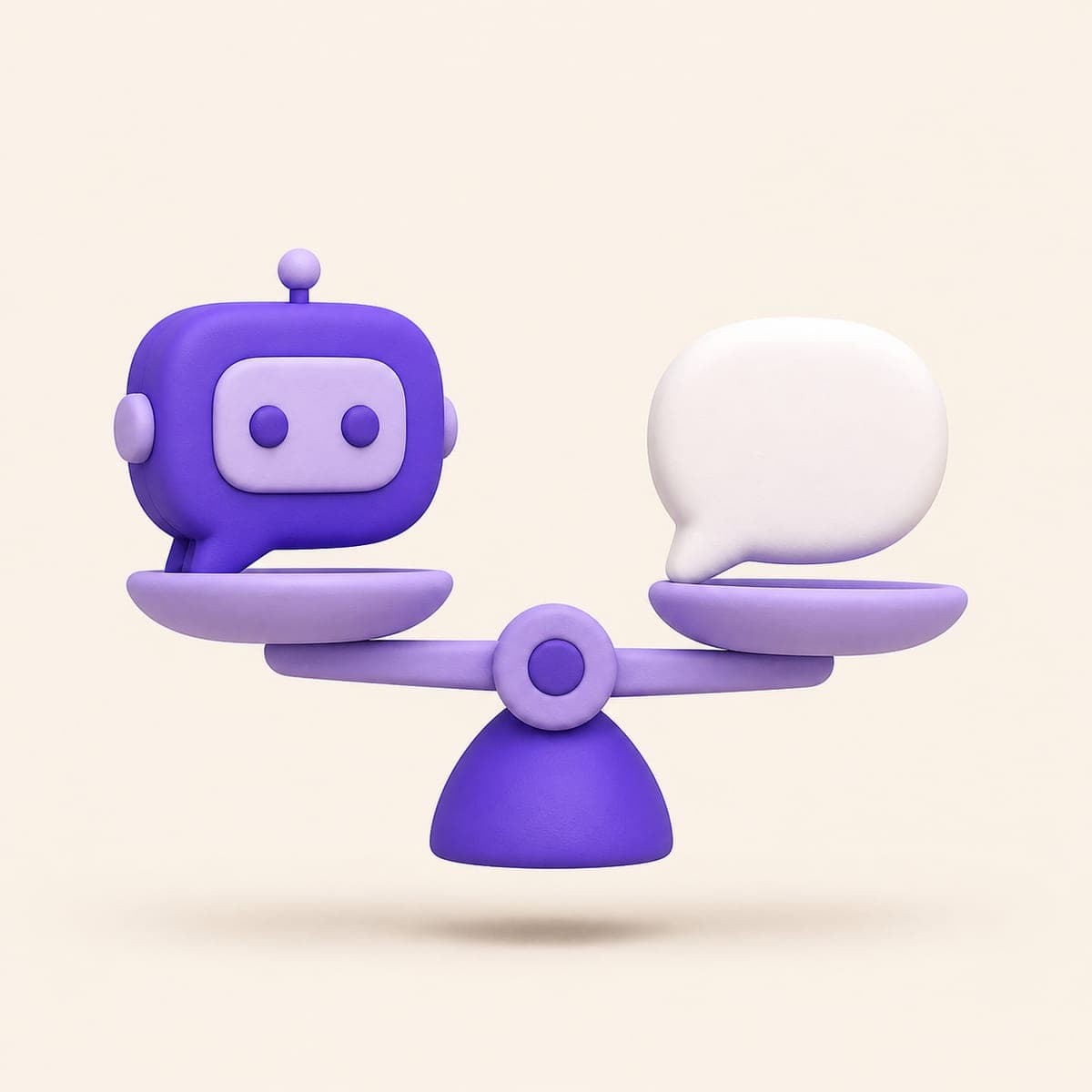
If we framed this as one or the other, we would be selling you a worse product than the one we believe in. The two tools are good at exactly the things the other is bad at. Live chat is judgment without scale. An AI chatbot is scale without judgment. Pick only one and you feel the gap immediately.
Go AI-only and your customers hit the dead end the moment their question is the slightest bit unusual, and they start spamming for a human who is not coming. Go human-only and your customers hit silence every night and every time you step away, and you burn your small team out answering the same password question for the thousandth time. Neither is a good place to be.
The honest recommendation for almost every small site is both, wired together: an AI that answers the easy, factual questions instantly and around the clock, and a human who picks up the moment the AI is out of its depth. Most tickets get a fast correct answer with no human time spent. The few that genuinely need a person reach one without a fight. That is the combination that makes customers trust your support instead of dreading it.
How the hybrid works without the dead end
The whole thing lives or dies on the handoff, so this is the part worth getting specific about. Three rules make a hybrid feel helpful instead of evasive.
The AI answers only what it actually knows. Most loops start with a bluff. If the bot guesses, gets it wrong, and then defends the wrong answer, you are in the argument everyone hates. The fix is to ground the AI on your real help docs and nothing else. muro's AI Answer Agent answers strictly from your help center, and you can point it at a URL so "Train on your site" builds that help center for you. It is instructed never to invent facts, prices, or features. If the answer is not in your docs, it does not improvise. It says so and hands off.
It escalates on the moments that need a human. Refunds, cancellations, anything account-specific, a visitor who is clearly frustrated, or simply low confidence: these all route to a person automatically. The customer never has to discover the magic phrase that summons a human, because the AI volunteers one before they hit a wall.
The AI backs off the instant a human replies. When a teammate types into the conversation, muro's AI goes quiet for that conversation. No talking over your agent, no awkward double-reply. And it is always labelled as AI, never a fake human name, so nobody discovers ten minutes in that "Sarah" was a bot the whole time.
Walk the refund case through. A visitor asks for a refund. Instead of arguing, the AI recognises it as an escalation trigger and hands the conversation to your inbox, telling the visitor a person is on it. A human replies and the AI stays out of the way. The visitor never typed "let me talk to a real person," because they never needed to. That same AI, a minute earlier, answered "where do I change my plan" instantly from your docs. Fast where it should be fast, human where it should be human.
What this costs, honestly
A fair worry with AI chat is the bill. muro is one tool that does both sides: a shared inbox for live chat and the AI agent on top, installed with one line of code. Plans are Solo at $19/mo for two projects and Fleet at $59/mo for unlimited, with a 14-day free trial and no charge today. To be straight with you, there is no free-forever plan.
AI runs on a monthly credit pool included in your plan, with no per-resolution fee, so a busy month does not turn into a surprise invoice. If you would rather not meter at all, you can paste your own Anthropic key with BYOK and run the AI unlimited at cost with zero markup. Either way you are not paying a toll every time the bot answers a question.
Live chat and AI chatbots are not rivals. One brings judgment, the other brings scale, and for a small site the version that actually works is the two of them together with a clean handoff in between. If you want to see the hybrid in practice, start a free trial and add it to your site this afternoon, or read how the AI agent hands off to a human first.